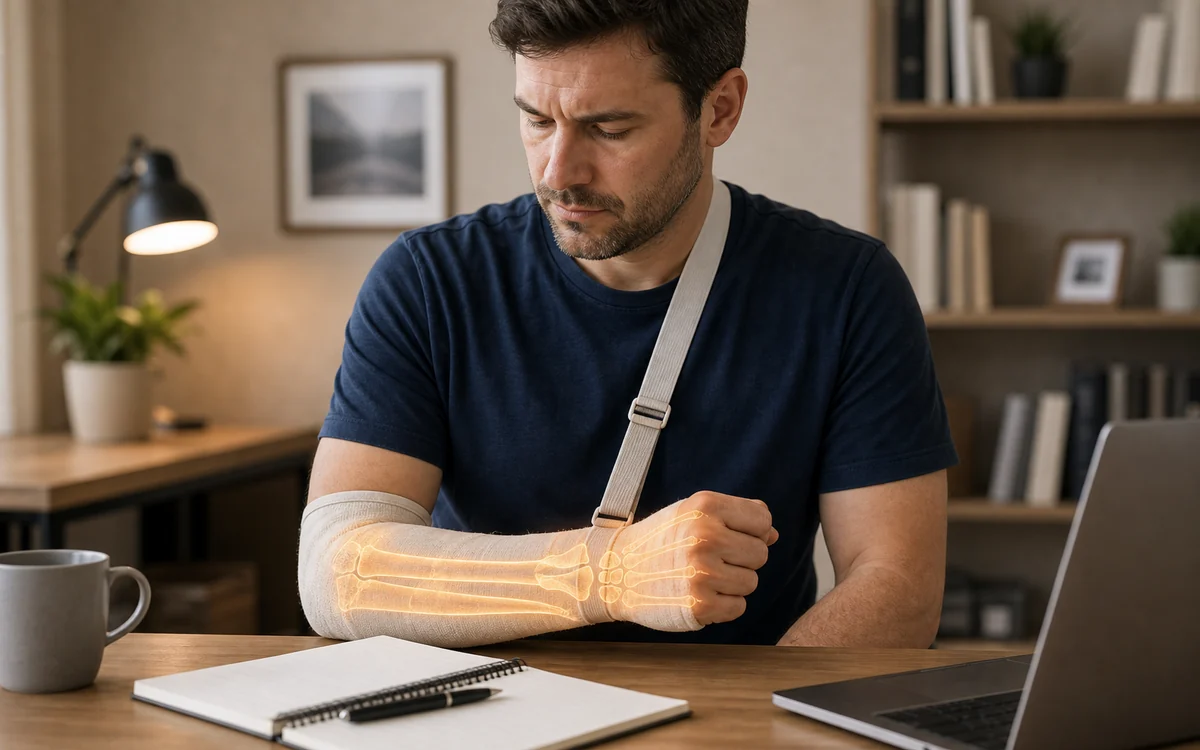
Can I claim for a fracture after a fall in NSW?
A fracture after a fall may raise a public liability, work injury or other claim pathway depending on where and how it happened, what evidence exists, medical records, work impact and dates.
Permanent impairment assessment
How permanent impairment is assessed for Fractures across spine, upper limb, lower limb and other body areas
Fracture WPI depends on the bone, joint surface, healing, alignment, surgery, residual ROM, nerve involvement and any NSW-modified table. The word "fracture" does not by itself determine a percentage.
What injuries can happen to this body part?
- Disc bulge, disc protrusion, disc prolapse or disc herniation
- Facet joint, ligament, soft-tissue or whiplash-type injury
- Radiculopathy, spinal stenosis, fracture, fusion or decompression surgery where supported by the medical evidence
Symptoms and findings that matter
- The exact fracture site and whether it involves a joint surface
- Displacement, comminution, malunion, non-union, arthritis or deformity
- Surgery, fixation, replacement joint or fusion if relevant
- ROM, nerve injury and function at MMI
- Which chapter and table applies to that fracture location
What investigations are usually relevant?
- Treating specialist report and final impairment assessment at maximum medical improvement
- Imaging, pathology, audiology, ophthalmology, respiratory, nerve or functional testing that fits the body system
- Operative reports, discharge summaries, rehabilitation records and objective clinical measurements where relevant
How WPI is assessed for this body part
- Fracture WPI depends on the bone, joint surface, healing, alignment, surgery, residual ROM, nerve involvement and any NSW-modified table. The word "fracture" does not by itself determine a percentage.
- Assessment source: the NSW Guideline chapter for the affected body area, with NSW-modified tables such as Table 3.2 for tibial plateau fractures and Table 4.3 for pelvic fractures where relevant.
- The assessor should explain maximum medical improvement, the body-system chapter, the method selected, any NSW modification, and why the objective findings fit that method.
How movement affects the assessment
- A fracture near a joint may affect movement; a shaft fracture may affect alignment, strength or function in a different way.
- ROM should be measured only after healing and stable recovery, and only under the method that fits the affected body area.
NSW Table 3.2 tibial plateau fracture rows
Undisplaced tibial plateau fracture2% WPI (5% lower extremity impairment).
Mild tibial plateau fracture5% WPI (12% lower extremity impairment).
Moderate tibial plateau fracture10% WPI (25% lower extremity impairment).
Severe tibial plateau fracture15% WPI (37% lower extremity impairment).
Severity factorsThe grade depends on weight-bearing area involvement, displacement and comminution.
NSW Table 4.3 pelvic fracture rows
Non-displaced healed pelvic fracture0% WPI where the NSW table criteria fit.
Pelvic bones, including sacrum, residual displacement less than 1 cm2% WPI where the NSW table criteria fit.
Pelvic bones, including sacrum, residual displacement 1 to 2 cm5% WPI where the NSW table criteria fit.
Pelvic bones, including sacrum, residual displacement more than 2 cm8% WPI where the NSW table criteria fit.
Pubic symphysis residual displacement less than 1 cm5% WPI where the NSW table criteria fit.
Pubic symphysis residual displacement 1 to 2 cm8% WPI where the NSW table criteria fit.
Pubic symphysis residual displacement more than 2 cm12% WPI where the NSW table criteria fit.
Pubic symphysis internal fixation or ankylosis5% WPI where the NSW table criteria fit.
Sacroiliac dislocation or fracture-dislocation, lower residual displacement row8% WPI where the NSW table criteria fit.
Sacroiliac dislocation or fracture-dislocation, residual displacement more than 1 cm12% WPI where the NSW table criteria fit.
Sacroiliac internal fixation or ankylosis5% WPI where the NSW table criteria fit.
Two out of three pelvic joints internally fixed or ankylosed8% WPI where the NSW table criteria fit.
All three pelvic joints internally fixed or ankylosed10% WPI where the NSW table criteria fit.
Multiple pelvic injuriesCombine values, with the maximum value for pelvic fractures limited to 20% WPI.
NSW Table 4.3 coccyx rows
Fractures of the coccyx: i. healed, and truly displaced fracture1% WPI. Pain alone is not the same as a truly displaced healed fracture.
Fractures of the coccyx: ii. excision of the coccyx5% WPI. Coccygectomy/excision is a separate higher category and should not be confused with ongoing tailbone pain.
Spine DRE category concepts, without guessing percentages
DRE IUsually no significant clinical findings. Do not use this guide to infer a percentage without the relevant AMA5 table.
DRE IIUsually minor objective findings, resolved radiculopathy, non-verifiable radicular complaints, or structural findings that fit the table.
DRE IIIOften relevant where radiculopathy is present or where the table criteria otherwise place the worker in category III.
DRE IVOften relevant where alteration of motion segment integrity, fusion-type criteria or higher-grade fracture criteria apply, depending on the region and NSW method.
DRE VCan involve radiculopathy plus alteration of motion segment integrity, but NSW modifies post-fusion radiculopathy treatment through Table 4.2.
Practical WPI examples
- A tibial plateau fracture has NSW Table 3.2 rows based on weight-bearing surface involvement, displacement and comminution.
- A wrist fracture may turn on wrist/hand ROM or malunion, while a vertebral fracture may turn on spine DRE, fracture criteria or neurological involvement.
- A coccyx injury should not be given a generic percentage; the NSW table distinguishes a truly displaced healed coccyx fracture from excision of the coccyx.
Evidence checklist
- A clear diagnosis and the body area being assessed
- Records showing the condition has reached maximum medical improvement, if that is the issue
- Specialist reports, imaging reports and treating notes relied on by the assessor
- Objective findings on examination, not only symptoms described by the injured person
- A work and treatment chronology explaining the injury, treatment, surgery and recovery path
- Any previous injury, degeneration, congenital issue or non-work cause that needs apportionment considered
- Initial imaging, CT where relevant, operative reports, fracture clinic notes, final alignment/healing evidence and functional measurements
What usually does not increase WPI
- Assuming a scan result automatically gives a WPI percentage
- Confusing pain, disability or inability to work with permanent impairment
- Ignoring maximum medical improvement before arranging an assessment
- Using an AMA5 table without checking whether the NSW Guidelines modify or replace it
- Double counting the same impairment through two methods when the Guidelines require one method
- Using a generic fracture percentage
- Ignoring the specific NSW table for the bone or joint involved
Assessment source
Assessment source: Assessment source: the NSW Guideline chapter for the affected body area, with NSW-modified tables such as Table 3.2 for tibial plateau fractures and Table 4.3 for pelvic fractures where relevant.
This section is source-backed general information. It is not a WPI assessment and is not legal advice.
Related injury and claim pages
Need a practical claim check?
If an impairment percentage, medical assessment or insurer decision is affecting your NSW injury claim, send the decision or report for a practical review. This is general information only and does not guarantee any result.
Request a free claim checkCommon accident contexts
Fracture claims usually begin with a clear incident, but the pathway still depends on where it happened, who was involved, what reports exist and how recovery affected work or daily life.
- Car accident and CTP claims involving fracture treatment after a crash
- Work injury claims involving falls, machinery, crush injuries or manual tasks
- Slip, trip and fall or public liability incidents involving impact or unsafe surfaces
- TPD issues where fracture complications or combined injuries affect long-term work capacity
Symptoms and treatment records that may matter
Medical records may include hospital records, imaging, surgery, immobilisation, pain, restricted movement, rehabilitation, infection or complication notes. Treatment should be guided by medical practitioners.
Evidence to keep
For fractures, keep hospital and imaging records, operation or follow-up notes, certificates, rehabilitation records, incident evidence, expenses and income or duties records.
- Hospital records, imaging, operation notes, certificates, rehabilitation and follow-up records
- Incident reports, photos, witness names, police, workplace or venue records
- Expense records, treatment costs, travel costs and equipment costs
- Payslips, rosters, duties lists and income records showing work impact
Ask which claim pathway may applyHow the injury may affect assessment
Fractures may affect work, driving, mobility, self-care, treatment attendance, domestic tasks and return-to-work planning. Claim assessment often needs records showing the recovery path and restrictions.
Common claim problems
These issues do not decide the outcome by themselves, but they are common reasons a claim needs careful evidence and chronology.
- Missing incident evidence after a fall or accident
- Treatment disputes about rehabilitation, surgery follow-up or equipment
- Income evidence that does not explain time off work or reduced duties
- Assumptions about outcome before recovery and evidence are clear
Mistakes to avoid
A fracture may be obvious medically, but the claim still needs incident evidence, recovery records and work-impact documents. Do not rely on the diagnosis alone.
- Discarding photos, reports or damaged items
- Not keeping medical certificates and follow-up records
- Returning to unsuitable work before restrictions are clarified
- Assuming a fracture by itself proves compensation is available
Claim pathway
How injury evidence is usually organised
This is a general pathway only. The documents, decision-maker and timing can change depending on the facts and claim type.
- 1
Injury or incident
Start with where and how the injury happened: road accident, workplace incident, public or private place, or a longer-term disability situation.
- 2
Medical treatment
Get appropriate treatment and keep certificates, referrals, scans, reports and notes about how symptoms affect work or daily life.
- 3
Evidence and chronology
Organise incident records, photos, witness details, wage records, claim numbers and correspondence in date order.
- 4
Insurer or super fund
The pathway may involve a CTP insurer, workers compensation insurer, public liability insurer or superannuation trustee/insurer.
- 5
Assessment or dispute
The insurer or fund may request material, assess treatment or work capacity, make a decision, or issue reasons that need a careful response.
- 6
Resolution or next decision
The practical outcome may be approval, payment, treatment support, further evidence, review, dispute steps or another decision point.
Documents and records
Injury evidence to organise early
The useful records depend on how the injury happened, when symptoms were recorded and how treatment or work capacity changed.
- Date, location and short description of the injury event
- Medical certificates, reports, scans, treatment records or hospital documents
- Employer, insurer, police, incident or venue records where relevant
- Photos, witness details, dashcam or other supporting material if available
- Income, superannuation, work capacity or leave records where relevant
- Letters, emails, claim numbers and decisions already received
Common questions
Injury evidence questions
Short general answers only. The right next step depends on the facts, dates and documents.
Can I claim for a fracture after a fall in NSW?
A fracture after a fall may raise a public liability, work injury or other claim pathway depending on where and how it happened, what evidence exists, medical records, work impact and dates.
What records matter after a fracture injury?
Hospital records, imaging, certificates, incident records, photos, witness details, expense records and work income records may matter. The pathway depends on how the fracture happened.
Which claim type might apply?
That depends on how the injury happened. The same injury can involve CTP, workers compensation, public liability, TPD or more than one pathway. Get advice if the pathway is unclear.